This post may contain affiliate links. Please see my disclosure policy for details.
Farmhouse Front Porch Lighting Ideas That’ll Make Your Neighbors Stop and Stare
Contents
- Farmhouse Front Porch Lighting Ideas That’ll Make Your Neighbors Stop and Stare
- Why Your Porch Light Choices Matter More Than You Think
- The Classic Move: Matching Wall Sconces That Never Go Wrong
- Breaking Down Your Fixture Options (Because Choice Paralysis Is Real)
- Design Elements That Separate Good From Great
- The Technical Stuff You Actually Need to Know
Farmhouse front porch lighting transforms a plain entrance into something that makes people slow down when they drive past your house.
I’ve spent countless evenings sitting on porches across the country, and I can tell you right now—the lighting makes or breaks the whole vibe.
You know that feeling when you pull up to a house at dusk and something just feels right? That’s not accident. That’s smart lighting doing its magic.
Why Your Porch Light Choices Matter More Than You Think
Let me be straight with you.
Your front porch is the handshake of your home. It’s what guests see first. It’s what you come home to after a brutal day at work. It sets the entire mood before anyone even opens the door.
I learned this the hard way when I first moved into my farmhouse. I slapped up some builder-grade light fixture and called it done. Big mistake.
The place looked flat, uninviting, and honestly a bit sad.
Once I switched to proper farmhouse lighting, everything changed. Suddenly my porch felt like a place I actually wanted to sit. Friends started commenting on it. My evening coffee routine became something I looked forward to instead of just another task.
The Classic Move: Matching Wall Sconces That Never Go Wrong
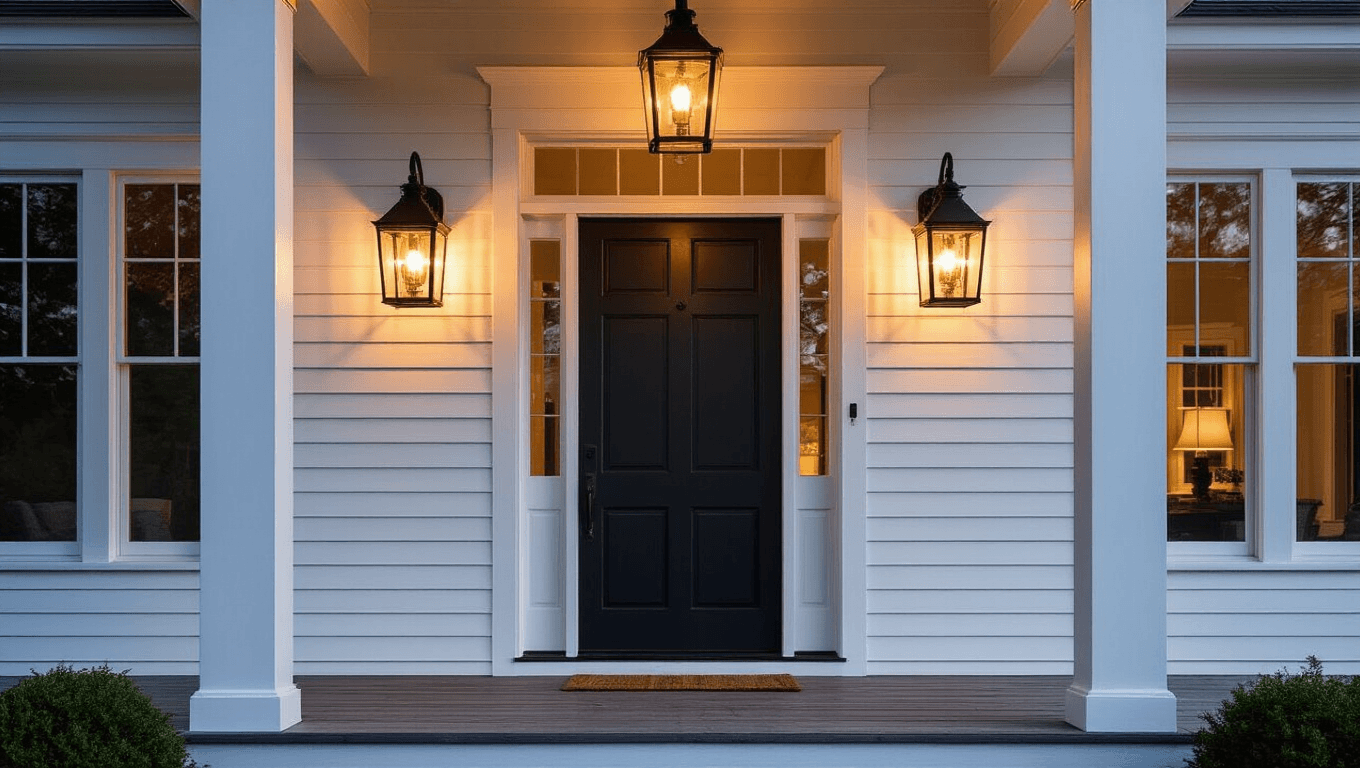
Matching wall sconces flanking your front door are the farmhouse lighting equivalent of a little black dress.
Classic. Timeless. Always works.
I’ve installed these on three different homes now, and each time the transformation is immediate.
Here’s why they work so well:
Visual Balance Your eye naturally seeks symmetry. Two matching fixtures create instant harmony that feels intentional and polished.
Functional Brilliance You get light exactly where you need it—on both sides of your entrance. No weird shadows. No fumbling with keys in the dark.
Architectural Integration Good sconces work with your home’s bones, not against them. They highlight the doorway without screaming for attention.

The Black Frame Advantage
Let me tell you about black-framed light fixtures.
They’re having a moment, and for good reason.
Black fixtures against white siding? Chef’s kiss.
I watched a neighbor struggle with brass fixtures for months, constantly cleaning them, worrying about the finish. She finally switched to matte black. The maintenance dropped to basically nothing, and her house went from trying-too-hard to effortlessly chic.
Black works with everything:
- White farmhouse siding
- Dark front doors
- Natural wood elements
- Stone accents
- Even colorful shutters
It’s the workhorse of farmhouse design.
Breaking Down Your Fixture Options (Because Choice Paralysis Is Real)
Walking into a lighting store can feel overwhelming. I get it. Let me simplify this for you.
Wall Sconces: Your Reliable Workhorse
Wall sconces are what I recommend to almost everyone starting out.
They’re mounted directly to your wall, usually flanking the door.
What makes them perfect for farmhouse style:
- Simple lines that don’t overcomplicate things
- Symmetrical placement that feels grounded
- Easy integration with existing architecture
- Budget-friendly compared to elaborate setups
I installed mine at about 66 inches from the porch floor to the center of the fixture. That height works for most standard doors and puts the light exactly where it’s useful.
Pendant Lights: When You Want Drama
Pendant lights hang down from your porch ceiling.
They’re bolder. More of a statement.
I have a friend with a deep covered porch who went this route. She hung two large drum-shade pendants over her seating area. The effect is stunning—like an outdoor room instead of just a porch.
But here’s the catch.
You need ceiling height. You need coverage from the elements. And you need to get the scale right or they look ridiculous.
Use pendants when:
- You have a deep, covered porch
- You’re creating a defined seating or dining area
- Your ceilings are at least 8 feet high
- You want to make a bold style statement
Ceiling Lights: The Formal Option
Flush or semi-flush ceiling fixtures add polish.
They’re more formal than sconces but less dramatic than pendants.
I think of them as the button-down shirt of porch lighting. Professional, clean, appropriate for any situation.
They work particularly well on smaller porches where wall space is limited or where you want even, overhead illumination.
Lanterns: Bringing That Vintage Soul
Farmhouse lanterns with clear or seeded glass nail the vintage aesthetic.
The seeded glass especially.
It diffuses light beautifully, creating this warm, slightly imperfect glow that feels authentic and lived-in.
I chose seeded glass for my own fixtures specifically because it hides the light bulb while still letting plenty of light through. The texture catches the eye without being fussy.
Mount them on the wall or on posts—both work.
Design Elements That Separate Good From Great
Let’s talk about what actually makes farmhouse lighting look intentional instead of random.
The Magic of Matte Black
Matte black finishes have taken over modern farmhouse design.
Not glossy. Not oil-rubbed bronze trying to look antique. Matte.
The finish reads clean and contemporary while still feeling grounded.
I’ve compared matte black side-by-side with other finishes, and nothing else has the same versatility. It doesn’t show fingerprints. It doesn’t glare in sunlight. It just quietly does its job while looking fantastic.
Glass Choices Matter More Than You’d Think
Clear glass is straightforward and honest. You see the bulb, you get maximum light output.
Seeded glass adds character. Those tiny bubbles and irregularities in the glass catch light and create visual interest. It feels handcrafted even when it’s not.
Frosted or milk glass softens everything. It’s gentler, more subtle, but can sometimes read too cottage-y for a true farmhouse look.
My pick? Seeded glass for most applications. It threads the needle between rustic and refined.
Silhouettes That Stand the Test of Time
The best farmhouse fixtures have vintage-inspired shapes with clean lines.
Not too fussy. Not too modern.
Think about barn lights, carriage house lanterns, and simple rectangular frames.
These shapes have been around for a hundred years because they work. They won’t look dated in five years when design trends shift.
I avoided anything with too many decorative flourishes or obviously trendy elements. Simple geometry ages better than complicated decoration every single time.
The Technical Stuff You Actually Need to Know
Okay, let’s get practical.
Light Color Temperature (It’s Not Complicated)
Use warm white bulbs around 3000K.
Not daylight. Not cool white. Warm. White.
Here’s why this matters:
2700K is too yellow, too much like old incandescent bulbs. 4000K and above starts looking like a hospital or office building. 3000K hits the sweet spot—inviting, natural, easy on the eyes.
I tested different temperatures on my own porch using smart bulbs. The difference is dramatic. 3000