

This post may contain affiliate links. Please see my disclosure policy for details.
Your Walls Are Doing Nothing Right Now (Let’s Fix That)
The walls in a toilet room are basically free advertising space for your design skills. Or lack thereof, if you’re leaving them contractor-white.
Paint: The Fastest Personality Transplant
I painted my toilet room a deep charcoal gray—Sherwin Williams’ Peppercorn, if you’re keeping notes—and the number of people who’ve complimented that four-by-five space is genuinely ridiculous.

Dark colors don’t make small rooms feel smaller. That’s a myth your aunt who still has carpet in her bathroom told you.
Here’s what actually works:
- Paint the walls AND ceiling the same color (it eliminates visual breaks and makes the space feel infinite)
- Use lighter shades if you’ve got terrible lighting or no window
- Try moody jewel tones like emerald, navy, or burgundy for instant sophistication
- Add a high-quality paint roller to your cart because cheap ones leave texture
The ceiling trick changed everything for me. No more “where do the walls end” awkwardness. Just one continuous, intentional color envelope.
Wallpaper: Maximum Drama, Minimum Square Footage
If paint feels too permanent or too boring, wallpaper is your best friend in small spaces. I used peel and stick wallpaper in a Victorian floral pattern for my mom’s powder room, and it took maybe two hours and one-and-a-half rolls.
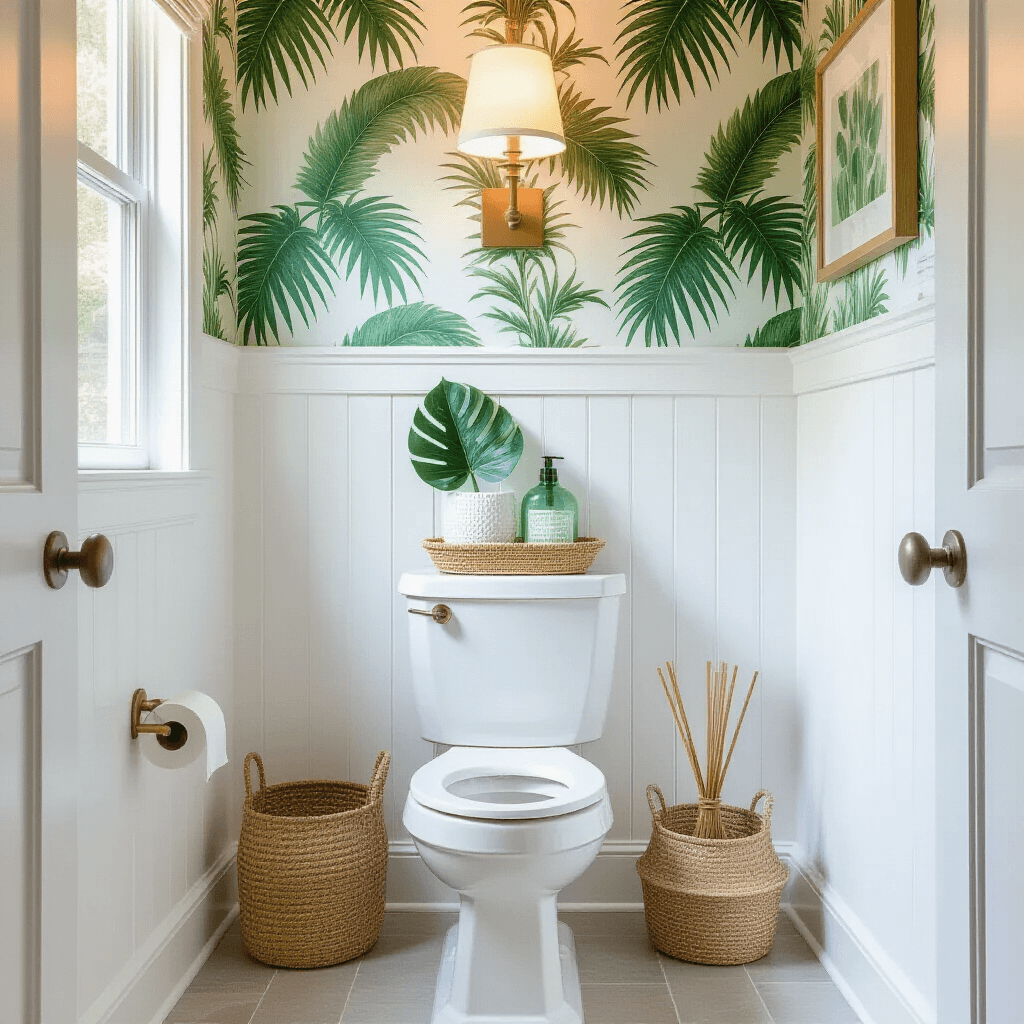
The beauty of wallpaper in toilet rooms:
- You need so little that even expensive patterns are affordable
- Peel-and-stick varieties mean zero commitment and renter-friendly installation
- Bold patterns that would overwhelm a living room feel perfectly sized here
- You can create that designer “powder room moment” everyone pins on Pinterest
Pro move: Don’t wallpaper behind the toilet.
Seriously. Install it on the upper two-thirds of your walls, then add molding at the divide point to create a faux wainscoting effect.
I learned this the hard way, contorted like a pretzel trying to smooth bubbles in a space my arms barely fit.
A simple white PVC trim cuts with regular scissors and installs with adhesive—no miter saw, no measurement anxiety.
Molding and Wainscoting: Fancy Without the Fuss
Real wainscoting involves panels, precision cutting, and patience I don’t possess. Fake wainscoting involves molding, a level app on your phone, and liquid nails.
The simple frame approach:
- Install vertical pieces on either side of your toilet
- Connect them with horizontal pieces at the top
- Paint everything the same color as your wall or go contrasting
- Bask in the “wow, is this original to the house?” comments
I did this in white against navy walls, and it looks like I hired someone who knows what a miter saw is.
(I still don’t.)
Gallery Walls: Art in Unexpected Places
People don’t expect art in the toilet room. Which is exactly why you should put it there.
Save this article
Enter your email and we'll send it straight to your inbox.
I printed a series of vintage botanical prints from Etsy—the digital download kind that cost $3—had them printed at Costco for another $12, and framed them in matching black frames from Amazon.
Total cost: under $50.
Total impact: “Did you hire a designer?”
Gallery wall guidelines for small spaces:
- Stick to one color frame (matchy-matchy works here)
- Use smaller prints (5×7 or 8×10) so they don’t overwhelm
- Arrange them before you hammer (I use painter’s tape to mock up the layout)
- Keep themes cohesive—all botanical, all vintage ads, all abstract
The wall opposite your toilet is prime real estate. You’re sitting there anyway. Give yourself something better to look at than the back of the door.
That Toilet Tank Isn’t Just for Flushing (Style It)
I never thought about my toilet tank as decorating space until I stayed at a boutique hotel that had this tiny vignette up there—flowers, a candle, some kind of artsy tray situation.
Mind. Blown.
The Tray Method: Corralling the Chaos
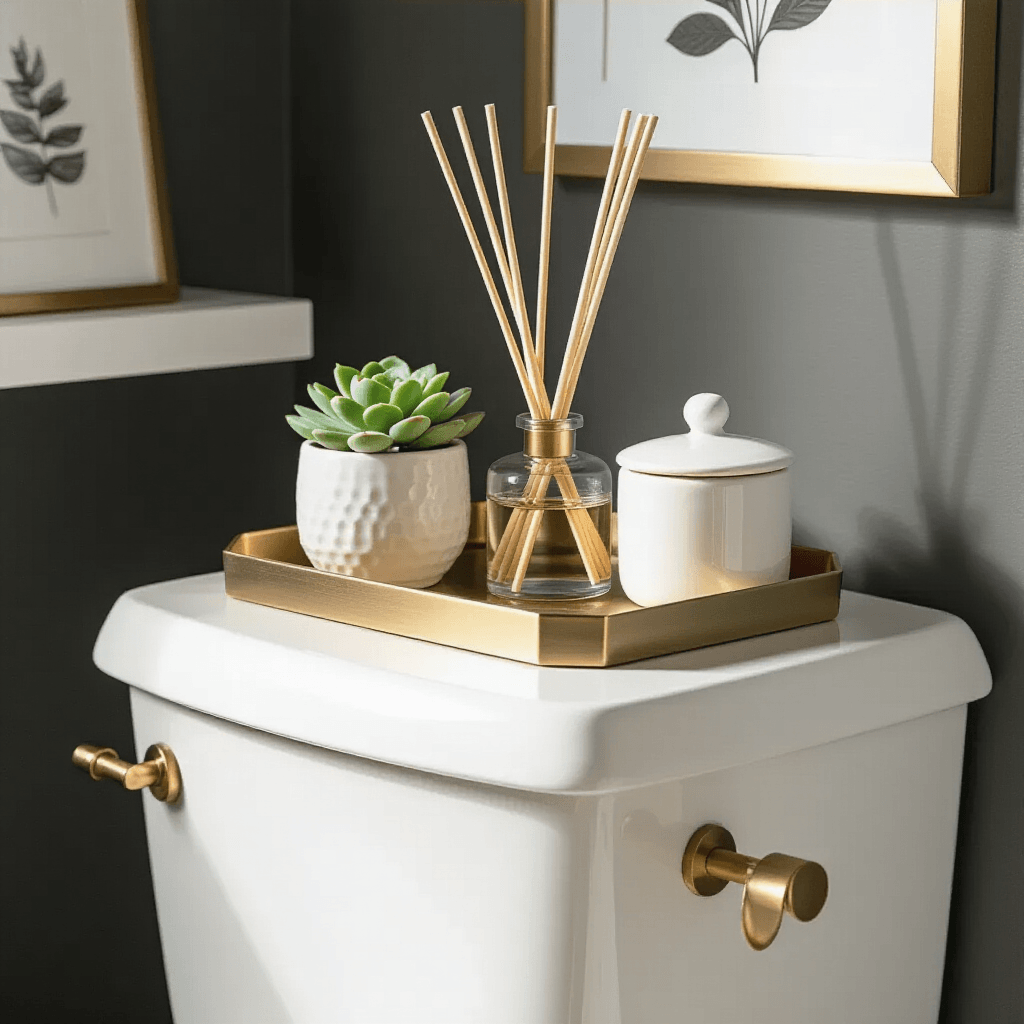
A decorative tray on the toilet tank is like a frame for your styling. It tells your brain “this is intentional design, not random objects.”
What I keep on mine:
- A small potted succulent (fake, because I kill everything)
- A reed diffuser in something that doesn’t smell like “generic bathroom”
- A decorative box for spare toilet paper rolls
The tray contains it all so it doesn’t look like I just… set stuff on the toilet. Which is literally what I did, but perception is everything.
Seasonal Swaps: The Fun Part
This is where I get a little extra, and I’m not apologizing for it.
My seasonal rotation:
- Fall: Mini pumpkins, a wheat bundle, maybe some fake maple leaves if I’m feeling it
- Winter: White ceramic houses, pinecones, a tiny bottle-brush tree
- Spring: Fresh flowers (or fake ones, no judgment), a pastel color scheme
- Summer: Coastal vibes—shells, driftwood, blue and white everything
It takes five minutes to swap out. And it makes me genuinely happy every time I walk in there. Which is multiple times a day, so the joy-per-effort ratio is excellent.
Storage That Doesn’t Look Like Storage
Lidded baskets and decorative boxes are doing two jobs at once. They look good AND hide toilet paper, feminine products, cleaning wipes—all the stuff you need but don’t want to see.
I use a woven basket with a lid that matches my tray. Inside: six rolls of toilet paper, a pack of cleaning wipes, and the “good” hand soap refills. Outside: just another design element.
<img
Keep this one for later
We'll email you the link so you can come back to it.


[…] and simple neutral styling. A black media console, dark framed art, and beige seating can make the room feel bold without being heavy. Add a light rug and warm wood accents to keep the space inviting. […]